Range anxiety-the fear that an electric vehicle will run out of battery before reaching a charging station-has historically deterred EV adoption. However, battery technology has advanced dramatically over the past three years. Today's leading electric vehicles offer ranges that satisfy most commuting patterns, especially when supported by workplace charging infrastructure. The gap between older EV models & current generation vehicles is striking.
Premium Range Leaders: Tesla Models
Tesla currently leads the EV range race with several standout performers. The Tesla Model S Long Range achieves approximately 405 miles of EPA-estimated range, making cross-state travel feasible without charging anxiety. The Model Y Long Range offers around 330 miles-impressive for an SUV that delivers excellent performance & practicality. Even the more affordable Model 3 Standard Range Plus delivers around 272 miles, sufficient for daily commuting with minimal range concerns.
These exceptional ranges stem from Tesla's advanced battery technology, optimized powertrain efficiency, & aerodynamic design. The Model S Plaid pushes performance boundaries while maintaining 340+ mile range. For tech professionals commuting between Bay Area offices or traveling between San Francisco & Los Angeles with charging infrastructure support, Tesla models essentially eliminate practical range concerns entirely. A single charge covers a typical week's driving for most professionals.
Midsize Range Leaders: BMW, Mercedes & Audi
The automotive industry has caught up significantly with Tesla's range capabilities. The BMW iX xDrive50 delivers approximately 380 miles of EPA-estimated range-nearly matching the Model S-while offering luxury amenities, spacious interior dimensions, & a premium charging experience. The BMW i4 eDrive40 reaches 303 miles with thrilling acceleration & traditional luxury vehicle features. The Mercedes-Benz EQS 450+ offers up to 370 miles, combining German engineering excellence with sophisticated infotainment & autonomous features. The Audi e-tron GT achieves 302 miles with stunning performance credentials.
These vehicles prove that luxury manufacturers have closed the range gap entirely. Employees & executives driving premium German vehicles no longer sacrifice range for comfort & prestige.
Practical Mid-Range Options: Chevy Bolt & Others
The Chevrolet Bolt EV delivers approximately 259 miles of range at a competitive price point, making it attractive for budget-conscious buyers seeking genuine practicality. The Nissan Leaf, once infamous for range limitations, now offers the Plus version reaching 226 miles-a solid improvement for commuter-focused drivers. The Hyundai Ioniq 6, Kia EV6, & Volkswagen ID.Buzz offer compelling mid-range options with 260-275 mile capabilities at reasonable price points.
These models serve most commuting needs effectively, especially when supplemented by workplace charging infrastructure. An employee driving a Chevy Bolt with access to Level 2 charging at work can charge to full capacity overnight or during work hours, completely eliminating practical range concerns for daily use.
Performance & Luxury Options
The Porsche Taycan maintains 300+ mile range while delivering supercar acceleration. The Rivian R1T (electric pickup truck) achieves up to 330 miles despite carrying cargo capacity. The Genesis GV70 Electrified & Lexus RZ offer 250+ mile ranges with luxury positioning. Even luxury performance brands previously skeptical of electrification-like Porsche with the Taycan-now deliver impressive range alongside thrilling performance.
Real-World vs. EPA Range Considerations
While EPA estimates provide useful comparisons, real-world range varies based on driving patterns, weather, & driving style. Highway driving at 70+ mph reduces range by 15-25% compared to EPA estimates. Cold weather reduces range by 20-40% depending on temperature. Conservative drivers maximizing efficiency may exceed EPA estimates. All About Parking's experience managing EV fleets confirms that EPA-rated range generally underestimates practical range for campus parking operations where vehicles move slowly, brake frequently, & benefit from regenerative braking advantages.
The Campus Charging Strategy Advantage
Workplace charging fundamentally changes the EV equation. Employees driving virtually any modern EV benefit enormously from Level 2 charging at the campus. A vehicle fully charged overnight at home & charged again during the workday can easily cover 500+ miles of driving without depleting battery capacity. This means range anxiety essentially disappears for corporate & campus employees with access to workplace charging infrastructure.
However, this benefit requires proper charging infrastructure placement, fair allocation among multiple vehicles, & professional management to prevent charging station congestion. Level 2 chargers typically add 25-30 miles of range per hour, so an 8-hour workday provides 200+ miles of charging-enough to fully restore most vehicles. Strategic placement of chargers in convenient lots, with weather protection & secure access, dramatically improves utilization & employee satisfaction.
The mathematics are compelling: an employee driving a Tesla Model 3 with a 272-mile range who charges 200 miles daily never approaches battery depletion. Even a conservative driver maximizing battery longevity experiences complete freedom from range concerns. For multi-vehicle households, workplace charging unlocks EV adoption by ensuring that long-range concerns never materialize in realistic usage patterns.
Why Professional EV Charging Management Matters
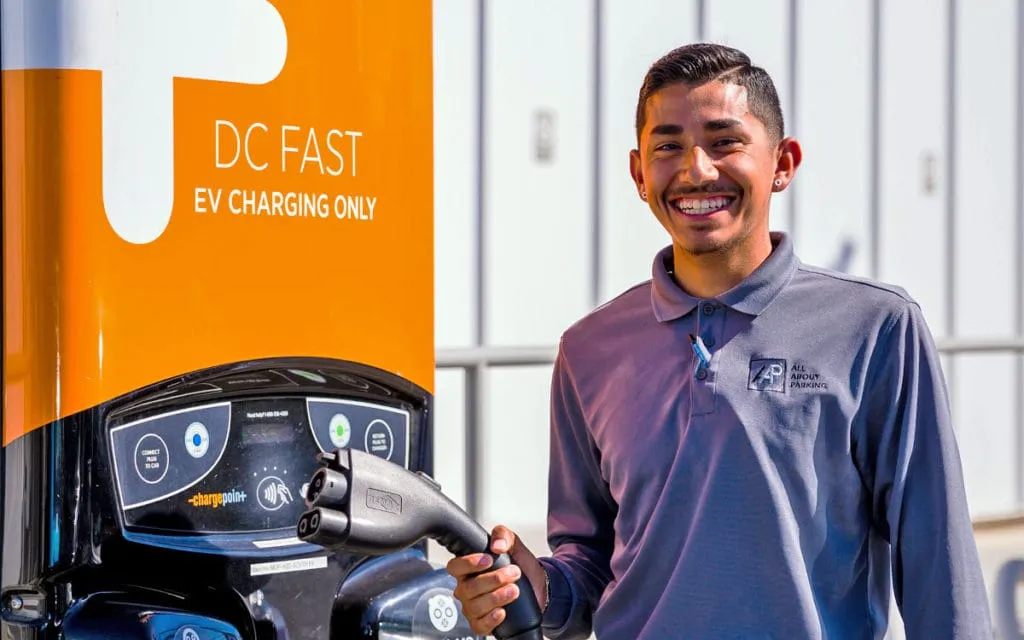
All About Parking's valet-managed EV charging service ensures your charging stations operate at peak efficiency, with intelligent vehicle positioning that maximizes charger utilization. We manage the logistics of moving vehicles when fully charged, ensuring fair access across your campus community, & troubleshooting any charging issues proactively. Our team monitors state-of-charge across your EV fleet, coordinates charging timing with peak availability periods, & ensures that no vehicle unnecessarily occupies a charger when others are waiting.
This professional approach transforms charging from a source of frustration & inefficiency into a source of employee satisfaction. Employees arrive to work knowing their vehicle will be charged & ready, fully charged vehicles won't be hogging chargers, & charging fairness means everyone gets equitable access.
The Path Forward
As battery technology continues improving with 2026 models introducing solid-state batteries in select premium vehicles, range capabilities will expand further. Corporate commercial parking management services that integrate EV charging management deliver both immediate benefits & future flexibility. When you partner with All About Parking, you gain expertise in EV operations, campus logistics optimization, & sustainable transportation strategy.
The era of range anxiety has definitively ended. Modern EVs offer practical, impressive range. Professional charging management ensures that your campus maximizes the efficiency & satisfaction that this technology delivers.